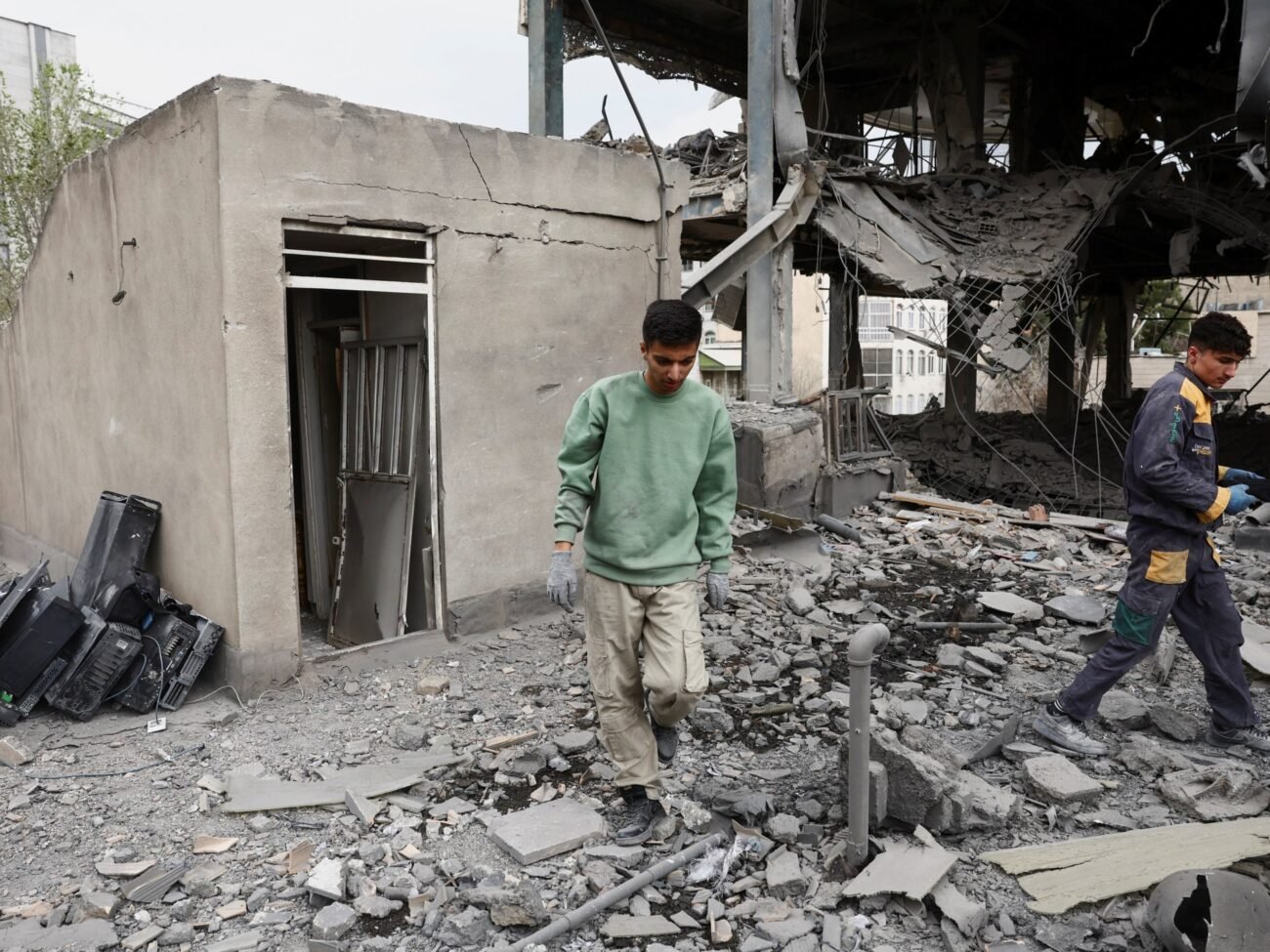
Iran’s parliament speaker has accused the United States of plotting a ground attack despite publicly pushing for a negotiated deal, as the US deploys thousands of military personnel to the Middle East.
“Our men are waiting for the arrival of the American soldiers on the ground to set them on fire and punish their regional allies once and for all,” Mohammad Bagher Ghalibaf said in a statement on Sunday, carried by the official IRNA news agency, as Iran struggled with power cuts amid escalating Israeli attacks on central and western areas of the country.
Recommended Stories
list of 3 itemsend of list
Iran’s Ministry of Energy reported power outages in the capital, Tehran, its surrounding region and neighbouring Alborz province on Sunday, “following attacks on electricity industry facilities”. The Fars news agency reported later that the outages were being resolved.
It was unclear whether the attacks were related to US President Donald Trump’s threats to strike Iranian power stations and other energy infrastructure if Tehran did not agree to a deal to end the war. Trump extended his deadline by 10 days through April 6 as Washington presented a 15-point plan for peace that critics described as “maximalist”.
Al Jazeera’s Ali Hashem, reporting from Tehran, said that authorities had activated substations to restore power. “This gives an indication of how much they’ve been also preparing for such situations,” he said.
Ghalibaf’s comments on Iran’s readiness for a ground assault came as The Washington Post reported that the Pentagon was preparing for weeks of limited ground operations in Iran, potentially including raids on Kharg Island, a crude export hub, and coastal sites near the Strait of Hormuz shipping chokepoint.
As the US-Israel war on Iran stretches into its fifth week, the Trump administration is also planning to send thousands of soldiers from the army’s 82nd Airborne to the region, following a US Central Command (CENTCOM) announcement Saturday that about 3,500 military personnel had arrived in the Middle East on board the USS Tripoli.
IRGC threatens retaliation after university attacks
The Israeli military said it dropped more than 120 munitions on sites used for research, development, and production of weaponry in Tehran on Sunday.
Iran’s Ministry of Health reported that 2,076 people had been killed since the start of the war, including 216 children.
Among the deaths, six people were killed in a US-Israeli attack on a residential area in the Iranian village of Osmavandan, according to the Mehr news agency, which added that five houses were destroyed and 22 were severely damaged.
A university in Iran’s central city of Isfahan said it was hit by US-Israeli air strikes on Sunday for the second time since the war erupted, leaving four university staff members wounded.
The strike followed an attack the previous day on Iran’s University of Science and Technology. After that attack, Iran’s Revolutionary Guard Corps (IRGC) said it would target two Israeli or US universities in the region in retaliation, according to Iranian state television.
Hossein Sadeghi, head of the Information and Public Relations Center at Iran’s Ministry of Education, told the IRNA news agency that at least 250 students and teachers have been killed amid strikes on 600 educational facilities across Iran since the war began.
Also on Sunday, a commercial building housing Qatar’s Al-Araby TV in Tehran was hit, with video footage showing walls and windows blown out of the multistorey block. “It was a real miracle we survived,” said Al Araby camera operator Mohammadreza Shademan. “There was no military target here”.
As the civilian cost of the war mounts, Iran is demanding compensation in a five-point plan presented to the US.
That plan also includes a halt to killings of Iranian officials, an end to hostilities, safeguards against the outbreak of more war, and Iran’s “exercise of sovereignty over the Strait of Hormuz”.
Iran, Hezbollah launch attacks
Israel’s military said on Sunday evening that it had detected seven new incoming missile salvoes fired from Iran during the day. These coincided with Hezbollah rocket attacks on northern Israel, with sirens triggered in more than 100 towns.
Israel’s ADAMA, a pesticide maker in the Neot Hovav industrial zone, located 9km (6 miles) south of the city of Beersheba, said its Makhteshim plant was hit either by an Iranian missile or debris from a missile. No casualties were reported, and no leak of hazardous materials was found.
Reporting from Ramallah in the occupied West Bank, Al Jazeera’s Nour Odeh said it was “an incident that raises a lot of alarms”.
“This industrial zone has about 19 different factories, including a bromide factory and some pharmaceutical factories. But it’s also home to the main hazardous disposal sites in Israel. So a lot is at stake here,” she said.
Another missile hit open ground near homes in Beersheba, injuring 11 people.
Israeli media reported that missile fragments fell on the northern port city of Haifa after missiles launched by Iran and Hezbollah were intercepted.
Houthis enter fray amid talks
As the war raged on, foreign ministers from Pakistan, Turkiye, Egypt and Saudi Arabia met in Islamabad, looking to de-escalate the conflict, which has also ensnarled Gulf nations hosting US military assets.
Across the Gulf, the United Arab Emirates said it had intercepted 16 ballistic missiles and 42 drones launched from Iran, while Saudi Arabia reported downing 10 drones. Sirens sounded in Kuwait and Bahrain.
The Iranian army said it had targeted US forces based in Jordan, launching drones on the living quarters and military equipment sites at the Muwaffaq Salti airbase in Azraq, the ISNA news agency reported.
Meanwhile, readying itself for attacks amid the US military build-up, an Iranian naval commander, cited by state media, said Iran had complete control of waters near the Strait of Hormuz, a vital chokepoint for a fifth of the world’s oil.
He said Iran was waiting for US forces to come within range, warning they could be targeted with coastal missile systems.
As oil prices shoot up and the world’s economy slides, the arrival of Yemen’s Houthis into the conflict, with Saturday’s strikes on Israel, further complicates matters, raising fears that the Yemeni group could block the Bab al-Mandeb Strait.
Houthi attacks on shipping vessels in the Red Sea during Israel’s genocidal war on Gaza upended commercial traffic worth about $1 trillion a year.
