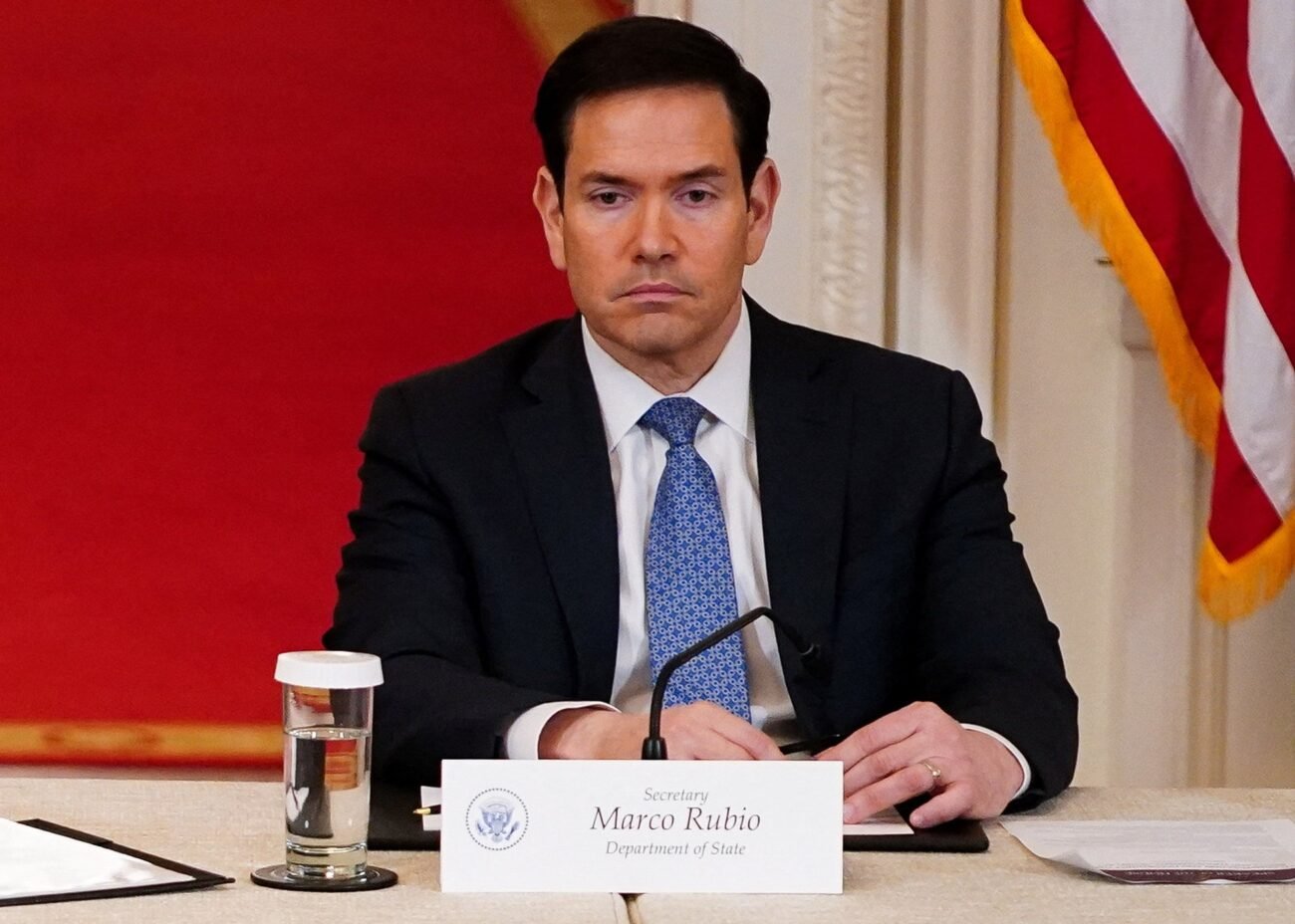
US Secretary of State Marco Rubio has said that talks with Iran are under way through intermediaries and that Washington will continue its military campaign until Tehran abandons its nuclear and missile programmes.
He warned on Monday that the Strait of Hormuz will be kept open “one way or another” and that US war objectives could be achieved “in weeks, not months”.
Recommended Stories
list of 2 itemsend of list
He also said the United States would welcome political change in Iran if the opportunity arose, but said it was not an official objective. Rubio criticised some NATO allies for refusing US access to bases during the war, and said Washington is closely watching developments in Cuba and Venezuela.
Here are the key takeaways from Rubio’s exclusive interview with Al Jazeera’s Hashem Ahelbarra:
Marco Rubio says talks with Iran are happening
Much of the communication between Tehran and Washington is indirect and through intermediaries, but Rubio insisted that it is ongoing.
He said there are “messages and some direct talks going on between some inside of Iran and the United States, primarily through intermediaries”, adding that the US president “always prefers diplomacy, always prefers an outcome”.
His comments come as US President Donald Trump escalated his rhetoric on social media, threatening to “obliterate” Iran’s energy infrastructure if a ceasefire is not reached soon, Al Jazeera’s Kimberly Halkett reported from Washington.
“Taken together, Rubio’s statements and Trump’s posts suggest the US is pursuing a dual-track approach: keeping diplomatic channels open through intermediaries while simultaneously increasing military and economic pressure on Iran,” she said.
US demands Iran abandon nuclear and missile programmes
Rubio said Iran must abandon its nuclear weapons ambitions and stop producing missiles and drones that can threaten countries across the Gulf region, and insisted “The Iranian regime can never have nuclear weapons.”
He said Iran’s missile programme poses a direct threat to countries across the Gulf, and claimed “These short-range missiles that they’re launching, they only have one purpose, and that is to attack Saudi Arabia and the UAE and Qatar and Kuwait and Bahrain.”
Rubio said Iran could pursue civilian nuclear energy, but not in a way that would allow it to quickly develop a nuclear weapon.
“What they cannot have is a system that allows them to quickly weaponise it,” he said. “They have to abandon all these weapon programmes and all their nuclear ambitions.”
However, Hassan Ahmadian, an assistant professor at the University of Tehran, questioned the narrative that Iran poses an offensive threat in the region.
“When was the last time Iran attacked its neighbours over three centuries?” Ahmadian asked, arguing that Iran’s military strategy is shaped by deterrence in an asymmetric conflict.
“Why is it doing this now? Because it’s the underdog in an asymmetric war that it wants to shield itself by expanding.”
Ahmadian added that Iran has been a central focus of US policy for years.
“With the break of two wars in less than a year, we have experienced, Iran has been on the table in different US administrations – all options are on the table,” he said.
Strait of Hormuz will be kept open ‘one way or another’
Rubio said the US would not accept Iran claiming sovereignty over the Strait of Hormuz and warned that the waterway would remain open regardless of Iran’s actions.
“Not only is the sovereignty over the Strait of Hormuz not acceptable to us, it won’t be acceptable to the world.”
“It sets an incredible precedent … nations can now take over international waterways and claim them as their own.”
“The Strait of Hormuz will be open … It will be open one way or another,” he said, adding that otherwise, Iran would “face real consequences” from the US and other countries.
Iranian analysts suggested the closure of the strait is a temporary wartime measure and could be reversed once the conflict ends.
“It’s opened partially,” Ahmadian said, adding “I think there is no Iranian interest to not open it beyond the war.”
“It’s an asymmetric way of putting pressure on Americans, just as they are bombing Iran, and so after the war there would be no need,” Ahmadian explained. “There will be an arrangement, according to the Iranians, with the GCC [Gulf Cooperation Council] countries to reopen it and see how things are managed.”
War objectives will be achieved ‘in weeks, not months’
Rubio said the US military campaign is progressing quickly and outlined the military objectives Washington is trying to achieve.
“Those objectives are the destruction of their air force, which has been achieved, the destruction of their navy, which has largely been achieved.”
“A significant reduction in the number of missile launchers… and we are going to destroy the factories that make those missiles and those drones.”
“We are well on our way or ahead of schedule.”
“We will achieve them in weeks, not months.”
“That’s a matter of weeks. I’m not going to tell you exactly how many weeks, but a matter of weeks, not months.”
Rubio says status of Iran’s new supreme leader is uncertain
Asked by Al Jazeera about his thoughts on Iran’s new Supreme Leader, Mojtaba Khamenei, Rubio said his status remains unclear.
“We don’t even know he’s in power. I know they say he’s in power. No one has seen him. No one has heard from him,” Rubio said.
“It’s very opaque right now. It’s not quite clear how decisions are being made inside of Iran.”
Iran’s leadership change is not an objective of the military operation
The US secretary of state suggested the US would welcome political change in Iran, though he said it was not the official objective of the military operation.
“We would always welcome a scenario in which Iran was led by people that had a different view of the future,” Rubio said. “If that opportunity presents itself, we’re going to take it.”
He said the Iranian people “deserve better leadership” and indicated Washington would not oppose a change in government if it occurred.
“Do we think the people of Iran deserve better leadership than what they’ve gotten from the clerical regime? One hundred percent,” Rubio said. “Would we be heartbroken if there was a change in leadership? Absolutely not.”
He also suggested the US would be willing to play a role if political change became possible.
“If there’s something we could do to facilitate that, would we be interested in participating? Of course.”
However, analysts said Washington’s position on regime change appears to have shifted over time.
“Originally bringing down the government was the goal; there has been a constant drawdown from that,” Paul Musgrave, a professor of government at Georgetown University in Qatar, told Al Jazeera.
“And now we have President Donald Trump on Truth Social saying he is negotiating with elements of what could become a new regime, so there is a lot of confusion here, but it is no longer the number one goal. It’s not something they are laying out,” he noted.
Rubio criticises NATO allies and warns alliance may be reviewed
Rubio said some NATO countries denied the US use of airspace and bases during the conflict and suggested Washington may need to reassess the alliance after the war.
“We have countries like Spain, a NATO member that we are pledged to defend, denying us the use of their airspace and bragging about it, denying us the use of their bases.”
“And so you ask yourself, well, what is in it for the United States?”
“If NATO is just about us defending Europe from attack, but them denying us basing rights when we need them, that’s not a very good arrangement.”
“All of that is going to have to be re-examined.”
