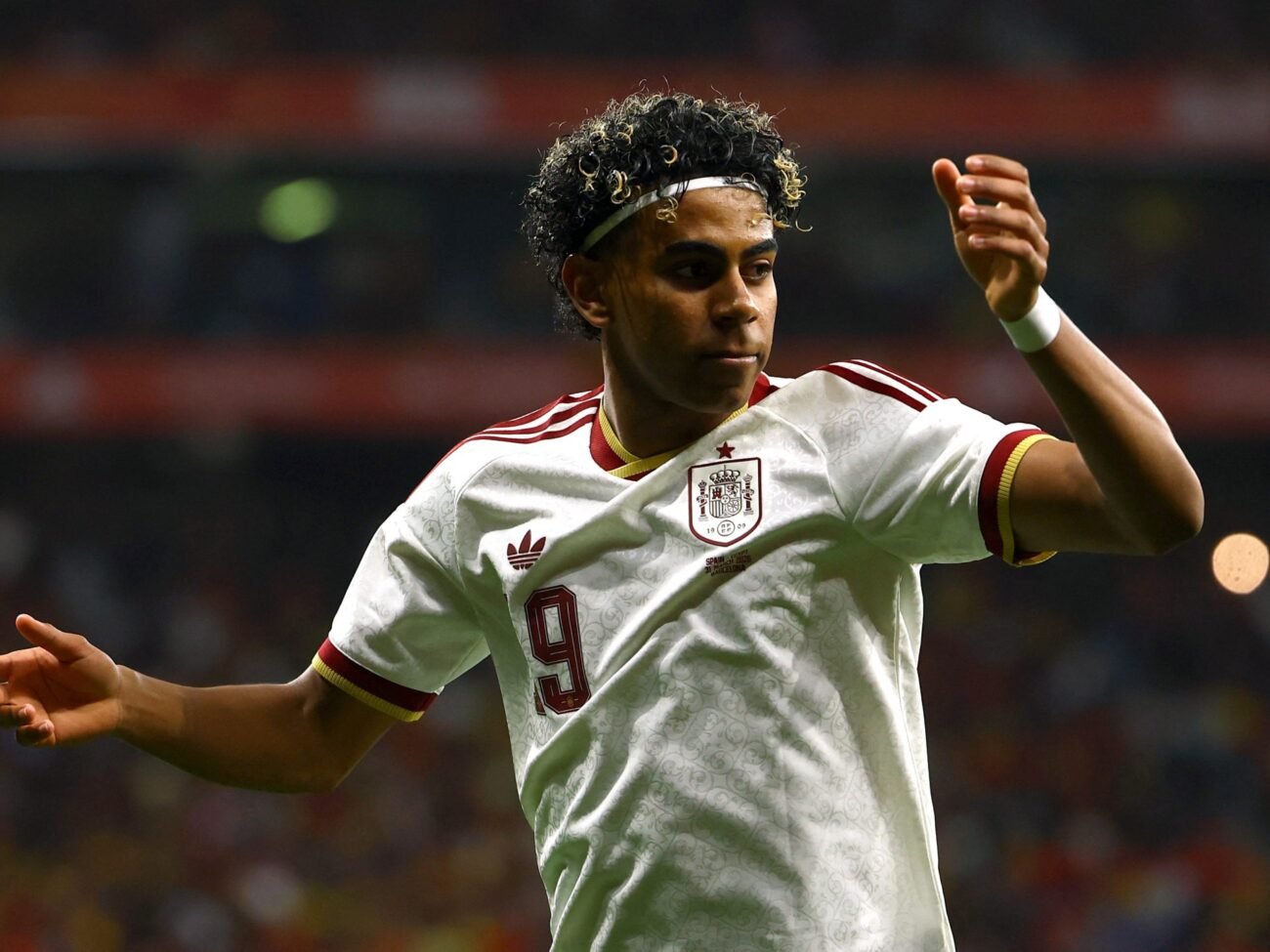
Madrid, Spain – Spain’s hopes of hosting the 2030 World Cup final were dealt a blow after racist chants marred what should have been a friendly match against Egypt.
The Spanish are to cohost the next edition of world football’s showpiece event with Morocco and Portugal, but the destination of the final has still to be decided by FIFA, the game’s global governing body.
Recommended Stories
list of 4 itemsend of list
Fancied as possible winners of this year’s World Cup in the Americas, Spain’s performance on the pitch on Tuesday was instead overshadowed by events off the pitch.
Spanish police have launched an investigation into “Islamophobic and xenophobic” chants which rang out twice during the 0-0 draw in Barcelona on Tuesday.
Authorities issued a warning on the public address system, then showed a video sign saying racist chants contravened the law, but these were jeered by sections of the fans.
A section of supporters had chanted: “Whoever doesn’t jump is Muslim” – a derogatory chant.
Al Jazeera’s correspondent, who was at the match, listened as Egypt’s national anthem also received a barrage of whistles before what was supposed to be a friendly game started.
It was the latest in a string of similar incidents to overshadow Spanish football in recent years, with Real Madrid’s Brazilian striker Vinicius Junior another high-profile victim of racial abuse in recent years.
Lamine Yamal, Spain’s star winger, a Muslim whose father moved from Morocco to Spain, issued a damning statement on Instagram in the wake of the row.
“I am a Muslim. Yesterday at the stadium the chant ‘the one who doesn’t jump is the Muslim’ was heard,” he posted.
“I know I was playing for the rival team and it wasn’t something personal against me but as a Muslim person it doesn’t stop being disrespectful and something intolerable.”
Yamal, who has never made any political statements, added, “I understand not all fans are like this, but to those who sing these things, using a religion as a mockery on the field makes you ignorant and racist people.”
Analysts said the anti-Muslim chants at the Spain match represent another proof of structural racism that exists in Spanish society, whose largest foreign-born population come from Morocco, a Muslim country.
“Spain is still a country which suffers from structural racism and there is little awareness of this. In contrast, other countries like the UK, France and the Netherlands, there is also structural racism but there is more awareness,” Moha Gerehou, former director of SOS Racismo, a national antiracism body, who is a journalist who specialises in xenophobia, told Al Jazeera.
“This exists in access to accommodation, schooling, personal relations, and work. When incidents like this occur, they still make excuses like the player is a provocateur like Vinicius Jr or in this case, that Islam is a problem.”
Gerehou noted a rise of far-right parties Vox, the third-largest in the Spanish parliament, and groups that were using racism to win votes and legitimise xenophobia.
“On the other hand, I think in Spanish society, there are more entities that are conscious of racism and are doing something to confront it,” he said.
In 2024, a report for the Spanish Observatory of Racism and Xenophobia, a Spanish government body, found that discrimination in sport and education starts at an early age.
Some 40 percent of children who were questioned said that in sport and at school in Madrid said their friends who were Black were treated differently.
Last year, another report for the same body found abuse at sporting occasions had moved from the stadiums to online.
In the 2024-25 season, there were 33,400 hate messages, of which 62 percent appeared on Facebook and 10 percent on X.
In the wake of the chants at the Spain match, Marca, Spain’s best-selling sport newspaper, ran a front page in black – which is usually reserved for the death of an important figure – quoting Yamal’s words.
The incident was widely condemned with Spanish Prime Minister Pedro Sanchez posting on social media that “we cannot allow an uncivil minority to the reality of Spain, a diverse and tolerant country.”
However, Santiago Abascal, Vox president, posted a message on X condemning those who criticised the chants.
“Today, those same people are tearing their hair out over a chant that isn’t even an insult, just a display of identity,” he posted.
“And they turn it into a matter of state. They expect Spaniards to silently and obediently put up with the Islamist invasion and the mafia government.”
The Catalan regional police force, the Mossos d’Esquadra, said it was investigating “Islamophobic and xenophobic” chants at the Spain-Egypt friendly match.
The Spanish Football Federation also condemned the chants, as did many leading footballers.
Vinicius Jr became a lightning rod for racist abuse since arriving in the Spanish capital in 2018 from Brazilians Flamengo.
In January 2023, Atletico Madrid fans hung an effigy of Vinicius from a bridge near Real Madrid’s training ground.
In 2025, five Real Valladolid fans, who racially abused Vinicius in a 2022 match, were found guilty by a court of committing a hate crime – the first such ruling in Spain for insults at a football stadium.
Graham Hunter, a British journalist who specialises in Spanish football, said efforts to combat racism in the sport have improved since he moved to the country in 2002.
“There is a racist, right-wing section of society, otherwise the Vox party would get no votes. But I’m hugely encouraged by the developments in Spanish football’s treatment of racism,” he told Al Jazeera.
“When I first moved here to today, the progress is significant. La Liga and clubs work hard to identify perpetrators and then expel or prosecute them.
“Football media devotes far more opprobrium towards racism than it did; these factors are part of the slow drive towards both punishment and re-education.”
