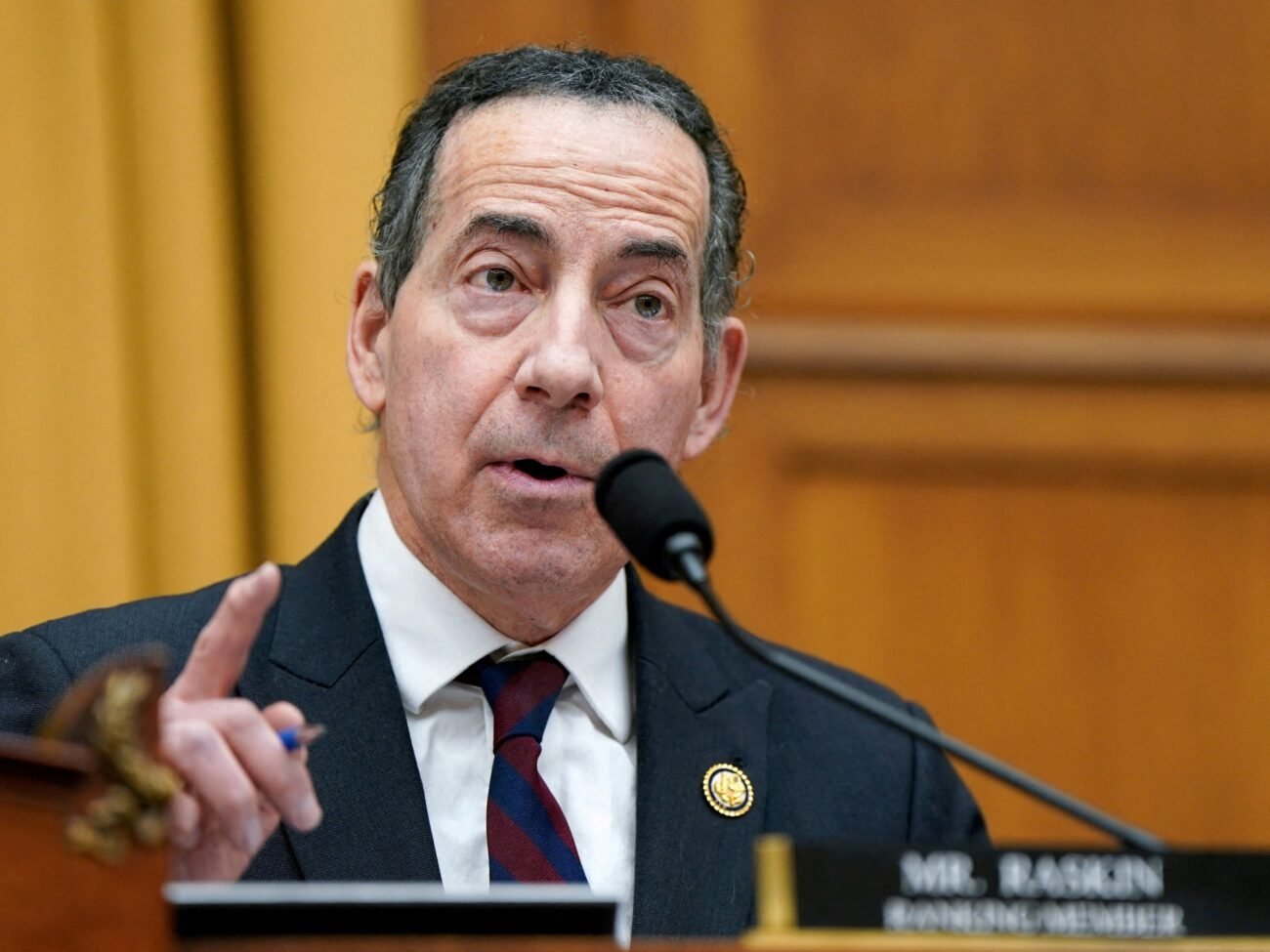
Jamie Raskin, the ranking Democrat on the House Judiciary Committee, has issued a letter to United States Attorney General Pam Bondi raising concerns about the classified documents President Donald Trump kept in his possession when he was out of office.
Those documents were the subject of a 2023 criminal indictment against Trump, which accused him of withholding and concealing government records despite official requests to return them.
Recommended Stories
list of 3 itemsend of list
The criminal charges were dropped before Trump’s return to office in 2025. But Trump has condemned the indictment as politically motivated, and Republicans on the House Judiciary Committee have sought to publish the investigative records related to it.
On Wednesday, however, Raskin argued in his letter that the newly released records raise further questions about the legality of Trump’s actions.
“These new disclosures suggest that Donald Trump stole documents so sensitive that only six people in the entire U.S. government had access to them,” Raskin wrote.
Other revelations, Raskin added, suggest Trump may have retained classified documents related to his business interests and that he may have shown a classified map to passengers on a private plane.
“This glimpse into the trove of evidence behind the coverup reveals a President of the United States who may have sold out our national security to enrich himself,” Raskin said.
He called for Bondi to answer a suite of questions by March 31 and to release the remaining investigative files by April 14.
The Department of Justice quickly responded by accusing Raskin of being “blinded by hatred of President Trump”.
“The accusations Raskin makes are baseless,” the department wrote in a statement, adding, “This letter is nothing more than a cheap political stunt.”
Democrats highlight new releases
In his letter, Raskin points to a 2023 memo in which prosecutors allegedly say that the Federal Bureau of Investigation (FBI) found classified documents that “would be pertinent to certain business interests” related to Trump.
Those documents, they wrote, reveal “a motive for retaining them”. They also noted that some classified documents had been “commingled” with records Trump made after his first term ended.
According to Raskin, prosecutors also discussed in the memo how sensitive some of the classified documents were.
They were assessed to be “the type of documents that only presidents and officials with the most sensitive authority have”, and their release posed an “aggravated potential harm to national security”.
In one instance, the memo reportedly explains how a Trump aide, Chamberlain Harris, scanned some documents onto her laptop and “uploaded the scan to a cloud”.
Raskin added that the subsequent text in the memo was redacted, “so we are unable to determine the full extent of this incident or whether these documents were compromised”.
He also noted that Trump’s current White House chief of staff, Susie Wiles, is identified in the memo as having “witnessed” an event where Trump took classified documents, including a map, on board a plane to his golf club in Bedminster, New Jersey.
“We do not know what that classified map contained, nor can we determine from this memo the relationship between the classified documents President Trump stole and their pertinence to his ‘business interests’,” Raskin wrote.
Raskin added that, if the Justice Department could release “cherry-picked” documents from the investigative file, it could release the entire file.
The classified documents case has remained in limbo since 2024, when the case was presented before the court of District Judge Aileen Cannon in southern Florida.
Cannon, a Trump appointee, dismissed the case on the basis that appointing a special counsel was unlawful, as the position had not been approved by the president or Congress.
Special counsels, however, have been used in the US government for decades. They are independent prosecutors appointed from outside the Justice Department to oversee investigations and indictments that may pose a conflict of interest to the executive branch.
The special counsel overseeing the classified documents case, Jack Smith, initially appealed Cannon’s ruling. But Smith dropped his case after Trump was re-elected in November 2024, given that the Justice Department has a policy of not prosecuting sitting presidents.
Questions over report’s release
However, before Trump took office in January 2025, there was a push to release Smith’s report on the classified documents case.
As of February, however, Judge Cannon has permanently blocked the release of that report, again arguing that Smith’s role as special counsel was not legal.
She also criticised Smith for drafting his report in the months after the case had been dismissed, describing the report as a “brazen strategem” to circumvent her ruling.
Journalism groups and government transparency watchdogs, however, have continued to fight Cannon’s rulings in court, arguing that suppressing — or even destroying — Smith’s reports would amount to an attack on government transparency.
In Wednesday’s letter, Raskin accused the Justice Department of selectively applying Cannon’s rulings, to either withhold or release Smith’s investigative records when convenient.
“The position of the DOJ appears to be that it can violate Judge Cannon’s order and grand jury secrecy whenever it sees an opportunity to smear Jack Smith,” Raskin wrote.
The Justice Department has responded that “Judge Cannon’s protective order was not violated”.
Meanwhile, the top Republican on the Senate Judiciary Committee, Chuck Grassley, said this week, “Our goal is to publicly release as many records as possible.” He has been a vocal critic of Smith’s investigation.
A former prosecutor for war crimes at The Hague, Smith was appointed as special counsel under the administration of Democratic President Joe Biden in 2022.
He oversaw two federal investigations into Trump between his two terms in office: one accusing the Republican leader of seeking to overturn his 2020 election defeat, and the other about his decision to withhold classified documents.
Trump was issued a subpoena to return all the classified documents in his possession after his first term, but a raid of his Mar-a-Lago estate turned up boxes with hundreds of sensitive government documents with classified markings.
Since returning to office for a second term, Trump has ordered the boxes to be returned to Mar-a-Lago.
