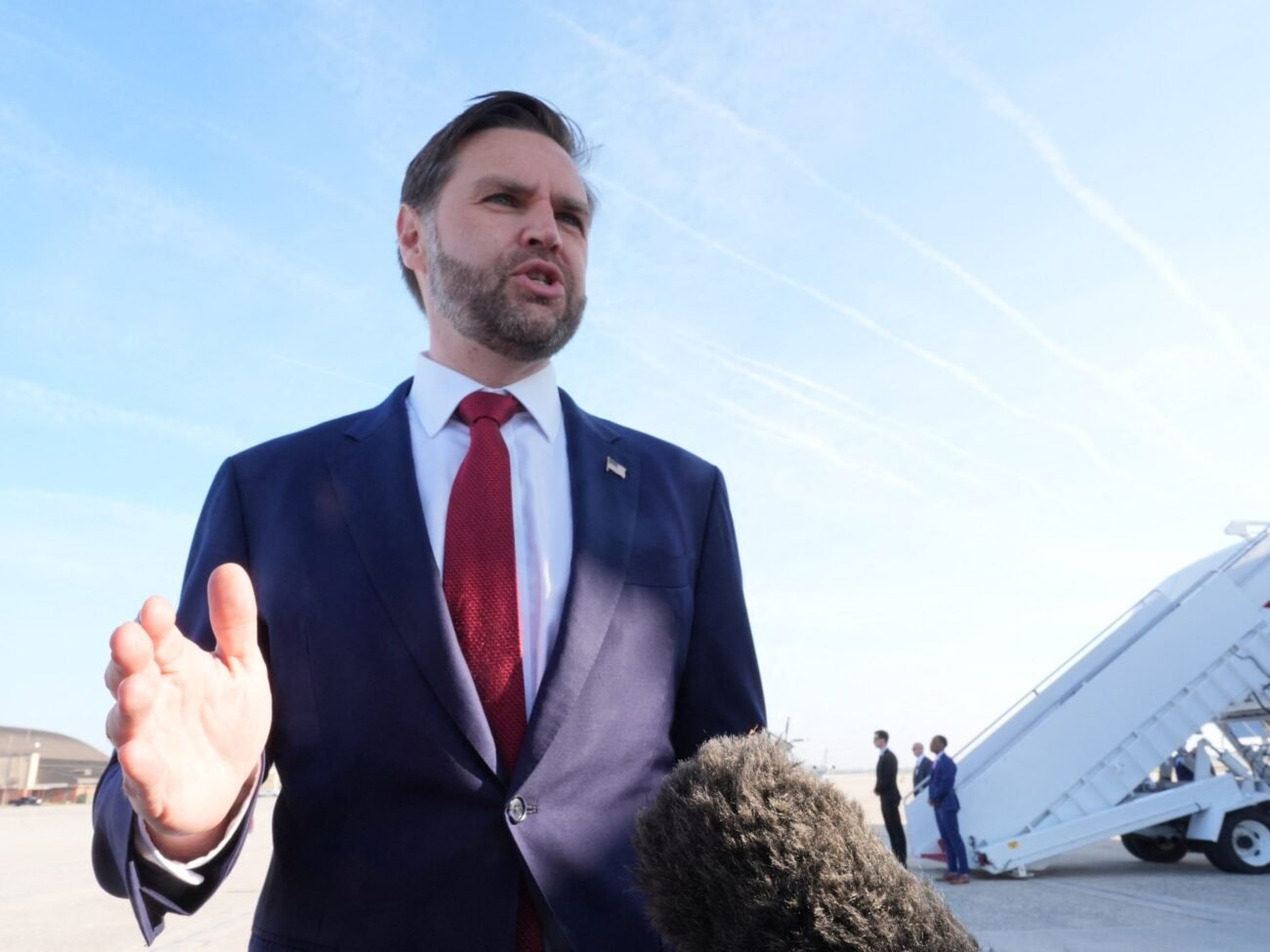
United States Vice President JD Vance has departed for Pakistan to engage in talks on ending the US-Israeli war with Iran, saying he expects “positive” results.
Vance spoke briefly to reporters on Friday as he boarded a plane bound for Islamabad, where talks with Iran were set to be held the following day.
Recommended Stories
list of 3 itemsend of list
“We’re looking forward to the negotiation. I think it’s going to be positive. We’ll, of course, see,” he said.
Vance added that President Donald Trump had given him “pretty clear guidelines” for the meeting.
“If the Iranians are willing to negotiate in good faith, we are certainly willing to extend an open hand, that’s one thing,” he said.
“If they’re going to try to play us, they’re going to find that the negotiating team is not that receptive.”
Some observers have seen the last-minute move to have Vance lead the US delegation as a sign of Iran’s wariness with US Special Envoy Steve Witkoff and Trump’s son-in-law Jared Kushner.
Witkoff and Kushner, who will still attend Saturday’s talks, had twice led indirect negotiations about Iran’s nuclear programme.
Those talks were ongoing when Israel initiated a 12-day war on Iran in June 2025, which ended with the US striking three of Iran’s key nuclear sites, and when the US and Israel launched the latest war on February 28.
While deeply loyal to Trump, Vance is also viewed as less hawkish than many of the president’s other top officials.
A former member of the US Marine Corps during the 2003 Iraq war, Vance has become representative of the anti-interventionist wing of Trump’s “Make America Great Again” (MAGA) movement.
“It’s interesting that JD Vance has been singled out to head this delegation. He hasn’t played much of a role to date,” Al Jazeera correspondent Mike Hanna reported from Washington, DC.
“One of the reasons, possibly, is because the Iranians had expressed their preference for dealing with Vance, rather than the other envoys who they have been dealing with.”
Iranian Parliament Speaker Mohammad Bagher Ghalibaf and Foreign Minister Abbas Araghchi are expected to lead the Iranian delegation, although it is not clear if any representative from Iran’s Islamic Revolutionary Guard Corps (IRGC) would attend.
The format of negotiations, and whether the US and Iranian officials would speak face to face or through intermediaries, was not revealed as of Friday.
From threat to ‘destroy civilisation’ to talks
The talks on Saturday will cap an extraordinary week in the war, which saw Trump threaten strikes on Iran’s civilian infrastructure, including power plants and bridges, if Tehran did not agree to his terms.
International law experts have said such strikes would likely constitute war crimes.
On Tuesday, just hours before the temporary ceasefire was announced, Trump went further, pledging that a “whole civilization will die tonight” if a deal was not reached.
While the pause in fighting has generally held, both sides have offered conflicting messages on the agreed-upon terms.
The Trump administration said it agreed to a 10-point plan put forward by Iran, but maintained the points are different from an earlier 10-point proposal it previously rejected.
No clarity has emerged on key issues, including control over the Strait of Hormuz, the future of Iran’s nuclear programme, and whether Israel’s invasion of Lebanon is subject to the ceasefire.
Both the US and Israel have maintained that pausing the fighting in Lebanon was not part of the initial ceasefire agreement, contradicting claims from Iran and Pakistan.
However, on Thursday, in a phone interview with an Israeli journalist, Trump said he told Israeli Prime Minister Benjamin Netanyahu to make the operations in Lebanon more “low key”, so as not to derail the talks in Pakistan.
In a phone interview with the New York Post on Friday, Trump re-upped his threat, saying the US was “loading up the ships with the best ammunition, the best weapons ever made” in the event the talks fall through.
Ghalibaf, meanwhile, cast doubt on whether the negotiations would move forward.
In a post on X on Friday, he maintained two conditions of the initial agreement had not yet been fulfilled. They included the “ceasefire in Lebanon and the release of Iran’s blocked assets prior to the commencement of negotiations”.
“These two matters must be fulfilled before negotiations begin,” Ghalibaf wrote.
Lack of trust
Iran’s Deputy Foreign Minister for Political Affairs Majid Takht Ravanchi, meanwhile, told a meeting of foreign ambassadors on Friday that Iran welcomed the Pakistan dialogue.
But Ravanchi added he remained wary that it could be used as a deception, to cover for renewed escalation in the fighting. He said Iran seeks an agreement with guarantees that it will not be attacked again.
Before the negotiations, the two sides appear to be “miles apart, and there’s tremendous amounts of mistrust” before the meeting, according to Ali Vaez, the Iran project manager at the International Crisis Group.
“In fact, I would argue that they’re beginning from a negative starting point now, because of their recent experience of the Trump administration bombing them twice in the middle of negotiations in the past year,” Vaez explained.
“However, the reality is that every option possible has been tried: Sanctions, economic coercion, military coercion, and both sides ended up in a lose-lose scenario towards the end of this conflict.
“And if they are practical, they’ll realise it is so much better and less costly … to do concessions at the negotiating table,” he added. “But that is much easier said than done.”
Reporting from Islamabad, Al Jazeera correspondent Osama Bin Javaid cited multiple sources as saying some “ground progress is already being made” before the arrival of the marquee negotiators.
But he noted it remains to be seen whether the US and Iran resume their negotiations from February, when talks about Iran’s nuclear programme were unfolding in Oman and Switzerland.
“Now the question is: Where does that framework begin? Is it going to be where they left off in Oman and in Geneva?” Bin Javaid said. “Or after the evolution of the last six weeks, it is going to start from scratch?
“What are the modalities that they will have to agree upon?”
