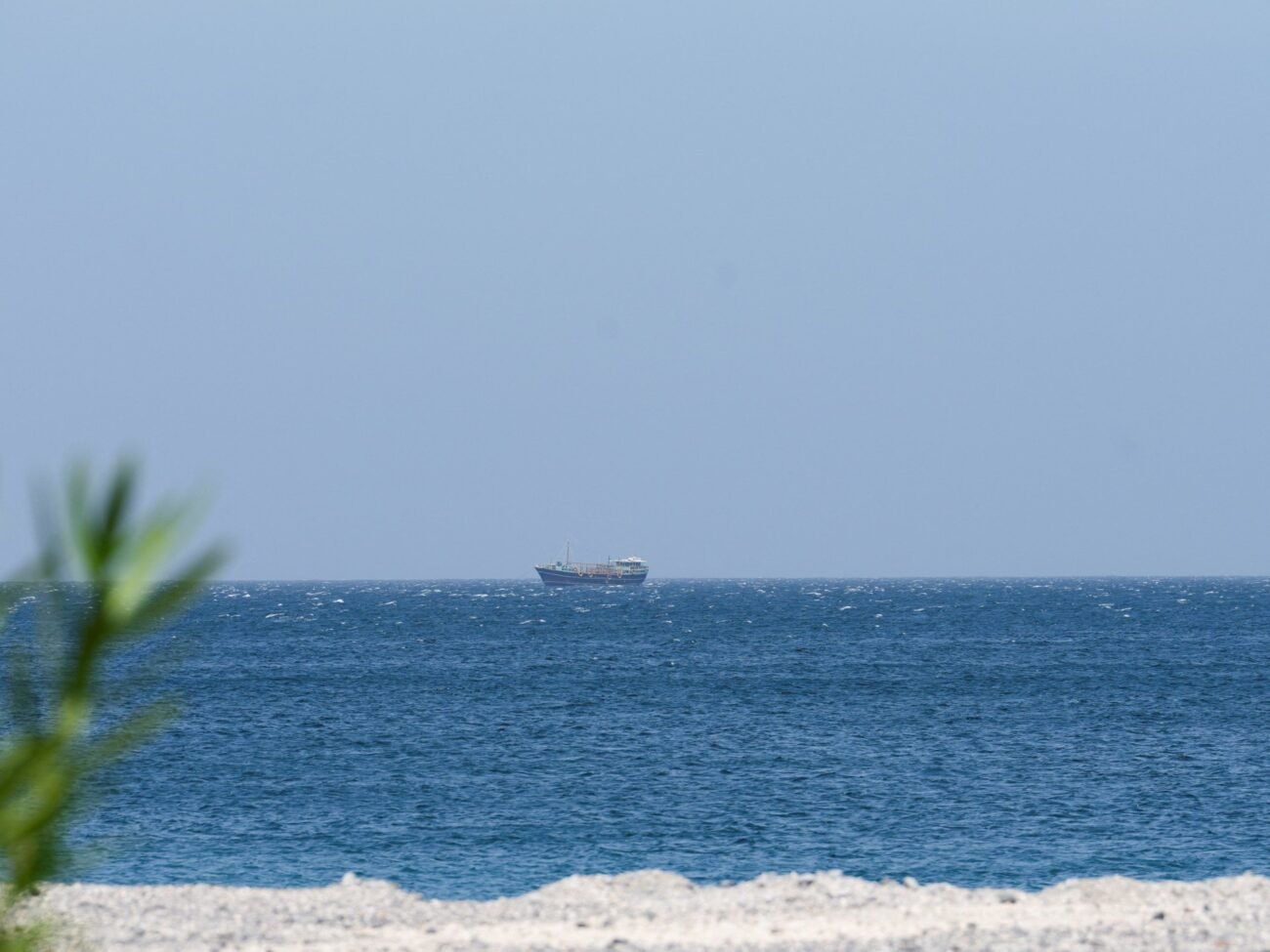
The United States military command that oversees the Middle East (CENTCOM) has said that two of its ships have travelled through the Strait of Hormuz, a claim swiftly denied by Iran.
On Saturday, the command said that the two destroyers, the USS Frank E Peterson and USS Michael Murphy, had “transited the Strait of Hormuz and operated in the Arabian Gulf as part of a broader mission to ensure the strait is fully clear of sea mines previously laid by Iran’s Islamic Revolutionary Guards Corps” (IRGC).
Recommended Stories
list of 3 itemsend of list
In a statement, US Admiral Brad Cooper hailed the ships’ presence in the strait as a turning point in the US and Israeli war against Iran, which began on February 28.
“Today, we began the process of establishing a new passage, and we will share this safe pathway with the maritime industry soon to encourage the free flow of commerce,” he said.
The passage would represent a major shift. Control of the strait has been a major point of contention, given that a fifth of the world’s oil and natural gas passes through the waterway, as well as large amounts of fertiliser and other goods.
Iran effectively closed the narrow strait, save for pre-approved ships, in the wake of the initial US-Israel attacks in February. That, in turn, snarled both commercial and military traffic and sent global fuel prices soaring.
On Saturday, a spokesperson for the Iranian military’s Khatam al-Anbiya Central Headquarters swiftly denied the US statement.
“The claim by the CENTCOM commander regarding the approach and entry of American vessels into the Strait of Hormuz is strongly denied,” the spokesperson said.
“The initiative for the passage and movement of any vessel is in the hands of the Armed Forces of the Islamic Republic of Iran.”
Speaking to Al Jazeera, Maria Sultan, the director general of the Pakistan-based South Asian Strategic Stability Institute, said that, if the US ships had indeed moved freely through the strait, it would have to have been with Tehran’s permission.
“So understand, [if] Iranians do not give a safe passage, it’s impossible for the American military fleet to move freely in the Strait of Hormuz,” she said in a television interview.
Ongoing talks
The back and forth came as US and Iran held negotiations in Islamabad.
The occasion included a historic face-to-face meeting between the US delegation — led by Vice President JD Vance — and the Iranian delegation, helmed by Iran’s parliamentary speaker, Mohammad Bagher Ghalibaf.
The talks represented the highest-level meetings of their kind since the Islamic revolution in 1979. They were launched after the US and Iran reached a preliminary ceasefire on Tuesday.
Both sides, however, have offered diverging accounts of the conditions for the negotiations. Entering into the talks, they remained at odds on key points, including the future of Iran’s nuclear programme, the release of frozen Iranian assets, and whether Israel’s invasion and its ongoing attacks in Lebanon were subject to the initial ceasefire deal.
Reporting from Tehran, Al Jazeera correspondent Ali Hashem said that Iranian officials appear to believe that an agreement had been reached for Israel to stop bombing Beirut and its suburbs. However, such an agreement has not been officially announced.
Meanwhile, Hashem pointed out that Iranian sources and news organisations have described the US as making “excessive demands”.
In particular, US and Iranian officials appear to remain at loggerheads over future control of the Strait of Hormuz.
Iran’s semi-official Tasnim News Agency reported on Saturday that the strait was among the main points of “serious disagreement” in the negotiations.
As part of the initial ceasefire agreement, Iran said it would temporarily reopen the strait to commercial shipping, although US officials noted delays due to the presence of mines in the waterway.
But Tehran has argued it must maintain its leverage over the strait as part of any deal.
It has also said it should be compensated for war damages. It has proposed levying tolls for passage through the Strait of Hormuz as a means of collecting such funds.
By contrast, the US has called continued Iranian control over the waterway a non-starter.
‘Big hurdles’
Despite some positive signs during Saturday’s talks, US President Donald Trump twice took to his Truth Social account to deny that Iran had entered the negotiations with the upper hand.
He wrote that “everyone knows that they are LOSING, and LOSING BIG!”
“The only thing they have going is the threat that a ship may ‘bunk’ into one of their sea mines which, by the way, all 28 of their mine dropper boats are also lying at the bottom of the sea,” he added.
Trump also revisited his claim that the Strait of Hormuz was less important to the US than its allies, which have largely rebuffed his request for military support in the waterway.
“We’re now starting the process of clearing out the Strait of Hormuz as a favor to Countries all over the World, including China, Japan, South Korea, France, Germany, and many others,” Trump said.
Reporting from Islamabad, Al Jazeera’s Kimberly Halkett explained that both sides at the negotiating table this weekend were working to overcome a “deficit of trust”.
“There are some of the big hurdles that need to be accomplished,” she said. “But I can tell you what’s happening right now in the hotel behind me is that they are working late into the night.”
