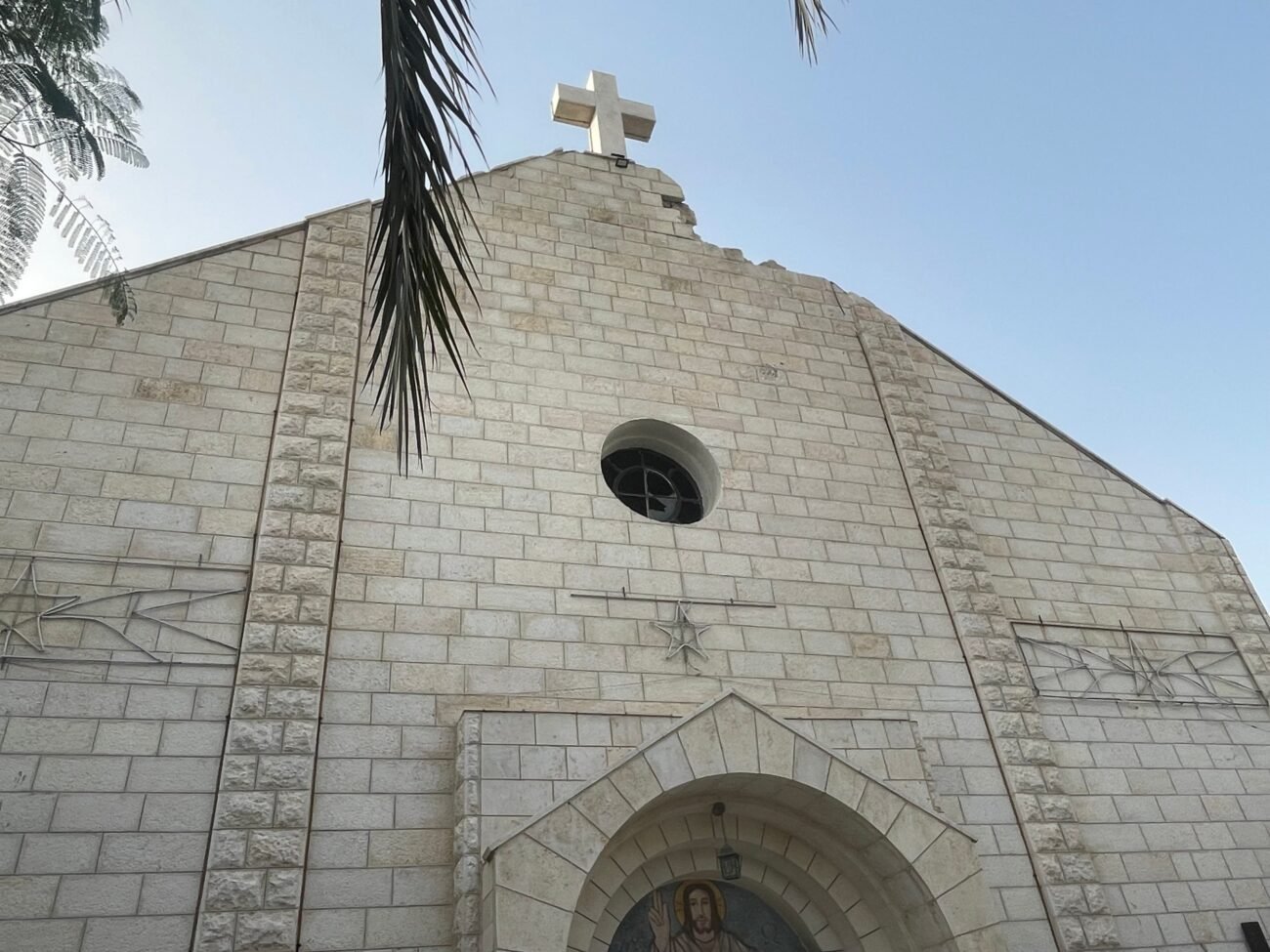
Gaza City, Gaza – Easter is a time of celebration for Christians worldwide, but for Gaza’s tiny Christian population, it is yet another sombre holiday amid Israel’s ongoing genocide.
Christians on Sunday marked their most important holiday, which celebrates the resurrection of Jesus Christ, amid displacement and severe shortages.
Recommended Stories
list of 4 itemsend of list
Gaza is home to fewer than 1,000 Christians. The community was already small before the war, and many of its members have been killed since then in attacks on their homes and churches. They are among the more than 72,000 Palestinians killed by Israel since October 7, 2023, the day it launched its war on Gaza after Hamas led deadly attacks inside Israel. A United Nations commission and human rights campaigners have called Israel’s war a genocide against Palestinians.
Inside Gaza’s churches, prayers, services and quiet gatherings carried deep meaning as families marked Easter while holding on to hope for survival and peace.
Many members of the community have fled the Gaza Strip, where Christians have lived uninterrupted for more than 2,000 years.
But shortages of basic items have cast a shadow on the holiday. Electricity, water and food, including eggs, which are a part of traditional Easter celebrations, are in short supply.
For decades, Israel has been deciding what goes in and out of Gaza. Those restrictions have been amplified during the genocide. Although a “ceasefire” has been in place since October, Israel has continued its stranglehold and attacks on the territory – home to more than two million Palestinians, the vast majority of whom are displaced.
Fouad Ayad, a bioenergy trainer who was displaced from his home near the al-Rantisi Children’s Hospital in western Gaza, said he has been searching for eggs across Gaza City but they are not available in the markets.
“We decorate eggs for the young children, and sometimes young Muslim children would visit us to get colourful eggs,” he told Al Jazeera.

Communal lunch
Fouad lamented that his family won’t have a communal lunch, a common Easter tradition, because meat is scarce and very expensive.
The 31-year-old reminisced about how he used to visit his relatives and friends during Easter, enjoyed the festive atmosphere and performed many traditions.
“We used to have a communal lunch together, and we would colour eggs. It was a beautiful holiday filled with joy,” he said, remembering the time before the war. “We used to visit the elderly and prayed for them and visited some Muslim neighbours.”
The Church of the Holy Family, which Fouad used to attend, had been attacked several times during the genocide. “In this church, three of my relatives were killed, and in another attack, more than 20 Christians were killed,” he said.
This year, attendance at Easter services at the only Catholic church in Gaza has decreased because of its members who have left the Strip. “Although we are a small minority, we will continue praying in our church,” he added.
“We only performed the prayers, refusing to celebrate because of our martyrs,” he told Al Jazeera, adding: “We, the Christians, are part of this land and suffered along with everyone in Gaza.”
“No matter what your political agenda or religion is, all of us Palestinians are targeted by the occupation.”
The Israeli restrictions in Gaza mean Christians have not been able to travel to the Old City in occupied East Jerusalem to attend services at the Church of the Holy Sepulchre for the past two years.
Last week, Israeli police prevented Cardinal Pierbattista Pizzaballa, the Latin patriarch of Jerusalem, from entering the Holy Sepulchre. Israel reversed the decision after international condemnation. The Al-Aqsa Mosque, Islam’s third holiest site, has also been closed to Muslim worshippers since the US and Israel launched their war on Iran.

‘I lost friends’
Elias al-Jelda from the Tal al-Hawa neighbourhood of Gaza City was forced to flee from his home with his five-member family when it was destroyed.
“I sought shelter in the Church of the Holy Family during the genocide, and since the ceasefire, I have been renting an apartment in the Sabra neighbourhood,” the 60-year-old said.
“Like many Christians, I refused to evacuate to southern Gaza, staying in the churches despite the dangers. Some of us stayed at the Church of Saint Porphyrius, but most of us remained at the Church of the Holy Family,” he said.
Elias, an active member of the Orthodox Church council of trustees and the workers union, said the church was struck several times.
“I lost friends, neighbours and relatives, many of them killed while trying to stay close to their homes and faith,” Elias said.
For Elias, Easter was a time of celebrations and happiness.
“Families celebrated at home, visiting relatives and welcoming friends. The church and houses were filled with traditions like coloured eggs, kahk [a locally baked biscuit], maamoul [date-filled biscuits], and Eidiya [a traditional gift],” he said.
“For some families, the celebrations extended to the West Bank, where the largest festivities were held.”
But celebrations are limited this year, and like Fuad, Elias also misses the festive atmosphere of the past.
“Traditional customs are incomplete, there are no eggs at all in the whole Strip. For children, there is nowhere to entertain, no amusement parks, no playgrounds, no gardens and no restaurants at affordable prices,” he lamented.
Elias also pointed to the acute power crisis. “Electricity continues to be a major problem for Palestinians. The soaring cost of diesel and generator oil has made it worse,” he said.
Amal al-Masri, 74, who is part of a six-member family, had lived in the Remal neighbourhood, which was one of the first areas to come under heavy Israeli bombardment.
Amal evacuated to the south and was displaced with her husband three times, first to az-Zahra, then to Rafah and Khan Younis.
“For two years in the south, there was no holiday at all,” Amal said. “Even on Christmas, there was no celebration of any kind. We did not even have chairs and had to sit on mattresses during prayers.”
Amal reminisced about how the celebrations had a special spirit before the genocide. Families invited one another for lunch and dinner, exchanged sweets and enjoyed each other’s company, she said. “We used to spend the whole day together, eating, talking and celebrating.”
This year, Amal and her community are trying to observe the basic rituals of Easter, but many of the traditions that once brought joy to children are still missing, especially coloured eggs.
“I looked for eggs everywhere, but couldn’t find any across the whole Strip,” she said.
