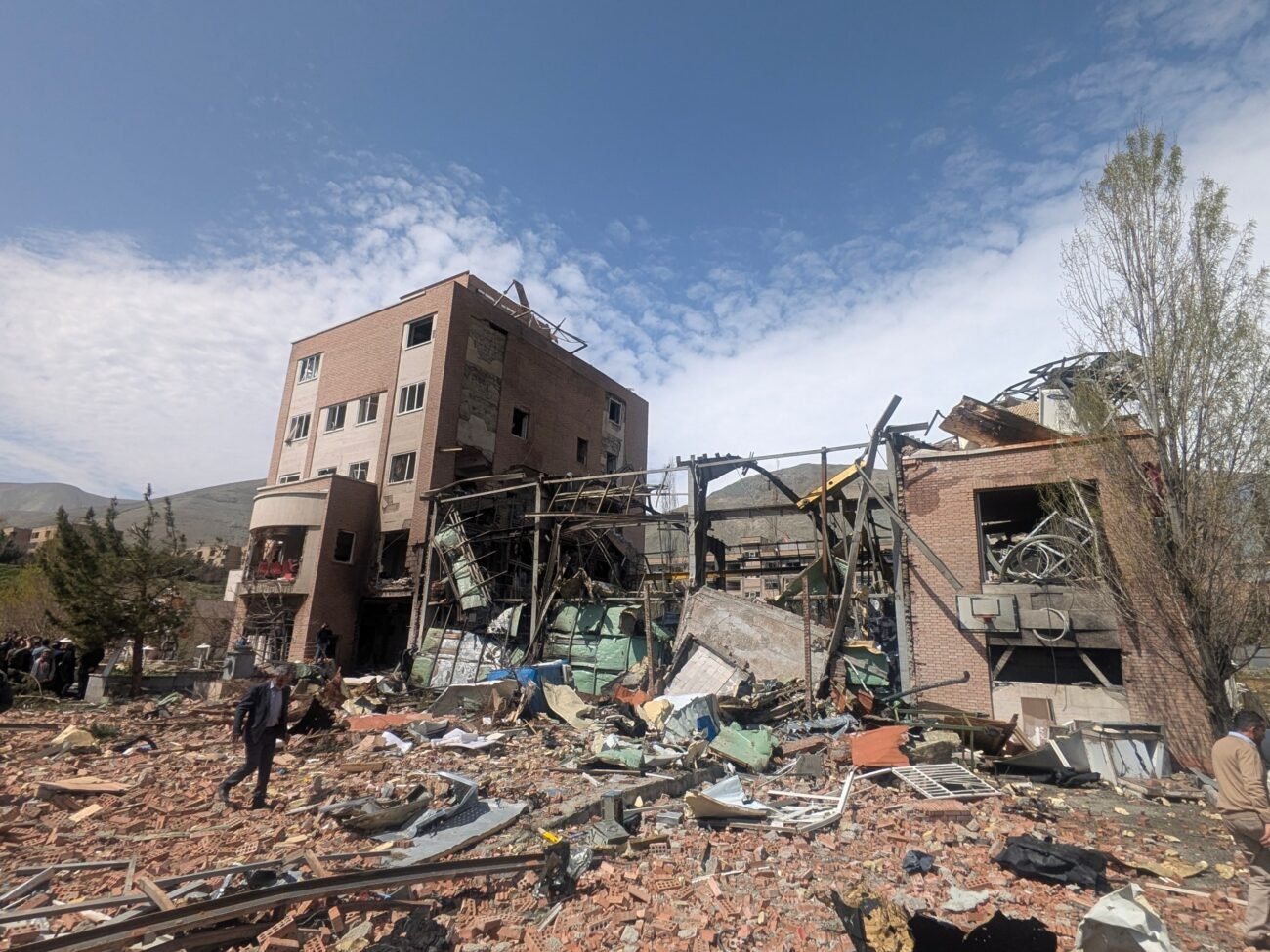
The United States-Israeli war on Iran has resulted in the widespread destruction of Iranian cultural heritage sites, as well as educational institutions and science and research centres.
While the US and Israel maintain they are striking military targets, the Iranian government’s data tells a story of cultural and scientific loss. At least 56 heritage sites, 30 universities and 55 libraries have been damaged so far, according to local media reports.
Recommended Stories
list of 3 itemsend of list
In an interview with Al Jazeera on April 1, Reza Salehi Amiri, Iran’s minister of culture and tourism, described the destruction during the US-Israel war on Iran as a “deliberate and conscious attack” on Iranian identity.
As the war continues to rage, we break down some of the key Iranian cultural and education centres targeted by the US and Israel so far.
Schools
The war on Iran began on February 28 with a strike on an elementary girls’ school, Shajareh Tayyebeh, in the city of Minab in southern Iran. At least 170 people, most of them girls aged between seven and 12 years, were killed when the missiles struck the school.
President Donald Trump initially denied that the US had attacked the school.
However, several independent investigations by media organisations, including Al Jazeera, and rights groups, including Amnesty International, have said the attack was likely deliberate and that a US-manufactured Tomahawk missile was used in it.
Universities and research centres
At least 30 Iranian universities have been attacked by the US and Israel since the war began on February 28.
On March 28, the Iran University of Science and Technology was hit by what Iranian media said were targeted Israeli-US strikes. It remains unclear what the damage and casualties from the strike look like.
A day later, a university in Iran’s central city of Isfahan said it was hit by US-Israeli air strikes for the second time since the war erupted, leaving four university staff members wounded.
On April 4, the Laser and Plasma Research Institute of the Shahid Beheshti University in northern Tehran was bombed by US and Israeli warplanes.
“This hostile act not only targets the security of academics and the country’s scientific environment, but is also a clear attack on reason, research, and freedom of thought,” the university said in a statement, calling on international peers to raise awareness about similar strikes.
Hossein Simaei Saraf, Iran’s minister of science, research and technology, told reporters at the research centre on Saturday that Iranian scientists have been targets for decades. He pointed out that several Shahid Beheshti University professors were assassinated by Israel during the 12-day war in June 2025.
“Attacking universities and research centres means returning to the Stone Age,” the minister said, in reference to a threat by US President Donald Trump to bomb Iran “back to the Stone Ages” by systematically hitting its infrastructure, including power plants.

The attacks on Tehran’s University of Science and Technology saw one of its research centres reduced to rubble and other departments damaged in late March. The facility worked on developing domestically made satellites.
The US and Israel also attacked the Pasteur Institute in downtown Tehran, which was founded more than 100 years ago in collaboration with the internationally renowned Institut Pasteur in Paris, but now operates independently. The institute works on infectious diseases, producing vaccines and biological products and providing advanced diagnostics.
On April 6, 2026, US-Israeli attacks hit Sharif University of Technology in Tehran, one of Iran’s leading scientific universities, often compared to the US’s Massachusetts Institute of Technology (MIT).
Al Jazeera’s Tohid Asadi, reporting from Tehran, said the facility was severely hit, with extensive damage reported in the compound’s mosque and laboratories.
“The Sharif area has witnessed other attacks, including one on a gas facility,” Asadi said, adding that other civil facilities, including roads, power plants and bridges, were attacked across Iran.
“Iran’s Ministry of Science and Technology told us that at least 30 universities have been hit” since the beginning of the war on February 28, he added.
Mohammad Reza Aref, Iran’s first vice president, accused the US of deploying a “bunker-buster” bomb to target the university.
“The bunker-buster bomb attack on Sharif University is a symbol of Trump’s madness and ignorance,” Aref said in a post on X.
“He fails to understand that Iran’s knowledge is not embedded in concrete to be destroyed by bombs; the true fortress is the will of our professors and elites,” Aref, a Stanford University-educated engineer, said of Trump.
Libraries
Besides schools, universities and science and research centres, libraries have also been hit.
The head of Iran’s public libraries’ association said on April 4 that at least 55 libraries have been damaged, including two that have been destroyed by US-Israeli strikes, Iran’s Tasnim news agency reported.
Cultural heritage sites
Since the US and Israel’s war on Iran began, the country’s Ministry of Cultural Heritage, Tourism and Handicrafts has recorded at least 56 museums, historical monuments and cultural sites that have been damaged. In Tehran alone, 19 locations have been hit. These included Golestan Palace, the Grand Bazaar and the former Senate building.
The Golestan Palace, which was damaged on March 2, dates to the Qajar era. This 1789-1925 period was marked by the rule of a Turkic dynasty that unified Iran after decades of civil unrest. The Qajar family made Tehran the capital of Iran.
Golestan is a walled palace built combining Persian craft and architecture with European motifs and styles. It features gardens, pools and ornaments. In Persian, “golestan” means “flower garden”.
Tehran’s Grand Bazaar, which was also hit, is a historic marketplace. Parts of it date back to the Qajar dynasty.

Beyond the capital, the strikes have reached the heart of Iran’s Islamic golden age.
In early March, in Isfahan, the 17th-century Chehel Sotoun Palace and the Masjed-e Jame – Iran’s oldest Friday mosque – were also hit. According to UNESCO, the mosque “illustrates a sequence of architectural construction and decorative styles of different periods in Iranian Islamic architecture, covering 12 centuries”.
“Restoration, no matter how perfect, can never return an artefact to its starting point,” Amiri, Iran’s minister for culture and tourism, told Al Jazeera on April 1.
“When you lose the original stone of a Qajar palace or the 17th-century tilework of an Isfahan mosque, you lose a physical layer of history that cannot be manufactured again. Every crack is a permanent scar.”
On March 8, the Falak-ol-Aflak Castle in Khorramabad in Lorestan province was also damaged, according to the head of Lorestan’s heritage department, Ata Hassanpour, who added that the main structure of the castle remained intact.
Amiri, in his interview with Al Jazeera, also condemned the international community’s silence and explicitly called out UNESCO for failing to intervene, despite having the geographical coordinates of all heritage sites.
UNESCO has confirmed that it has verified damage to historic sites in Iran.
The UN agency said that before the war, it had provided all parties with the geographical coordinates of heritage sites so they could “take all feasible precautions to avoid damage”, The Associated Press news agency reported on March 12.
Is this all part of the US and Israel’s broader strategy in Iran?
Ali Vaez, the International Crisis Group’s Iran project director, told Al Jazeera that what Israel and the US are seeking by destroying Iran’s industrial and educational capacity is to prevent reconstruction – in a bid to turn the country of 92 million people into a failed state.
But he added that “a civilisation that has survived several millennia cannot be erased with aerial bombardment.”
Christopher Featherstone, associate lecturer at the Department of Politics and International Relations at the University of York, said that Washington’s public statements amid the US-Israeli airstrikes hitting cultural monuments and education institutions were also a break from the past.
A different administration, he suggested, would have tried to portray such attacks “as exceptional and accidental,” he told Al Jazeera.
“For this administration, Trump’s extreme rhetoric is almost seeking to normalise them. Trump’s blatant attempts to suggest someone else was responsible for the strikes on the girls’ school a few weeks ago also shows just how little effort he is putting in to establishing a narrative to justify this war,” he added.
Do the US and Israel have a history of such attacks in the Middle East?
Yes. The US and Israel have carried out similar attacks in the past, particularly in Gaza and Iraq.
Iraq
The 2003 US‑led invasion of Iraq set the stage for the looting of the Iraq National Museum in Baghdad, where thousands of artefacts were stolen or destroyed.
The same year, US troops watched as looters plundered the Iraq National Library and Archives in Baghdad, and set the building on fire. More than 90 percent of rare books in the library were destroyed.
Gaza
In Gaza, according to UNESCO’s data this year, Israel destroyed or damaged nearly 200 heritage sites during its genocidal war on the enclave, which began in October 2023. While a ceasefire has been in place since October 2025, Israeli attacks on Gaza continue.
Some of the heritage sites damaged include the Byzantine Church of Jabalia, which was built in 444 and whose floor was once decorated with colourful mosaics depicting animals, hunting scenes and palm trees. The church was destroyed in October 2023. The Anthedon Harbour, built in 800 BC, was destroyed by Israel in November 2023. After Roman temple ruins and mosaic floors were discovered on the 5-acre (2-hectare) archaeological site, it was placed by UNESCO on its Tentative World Heritage list in 2012.
Gaza’s Great Omari Mosque, the city’s largest and oldest mosque, established in the seventh century, was also destroyed by Israel in December 2024.
