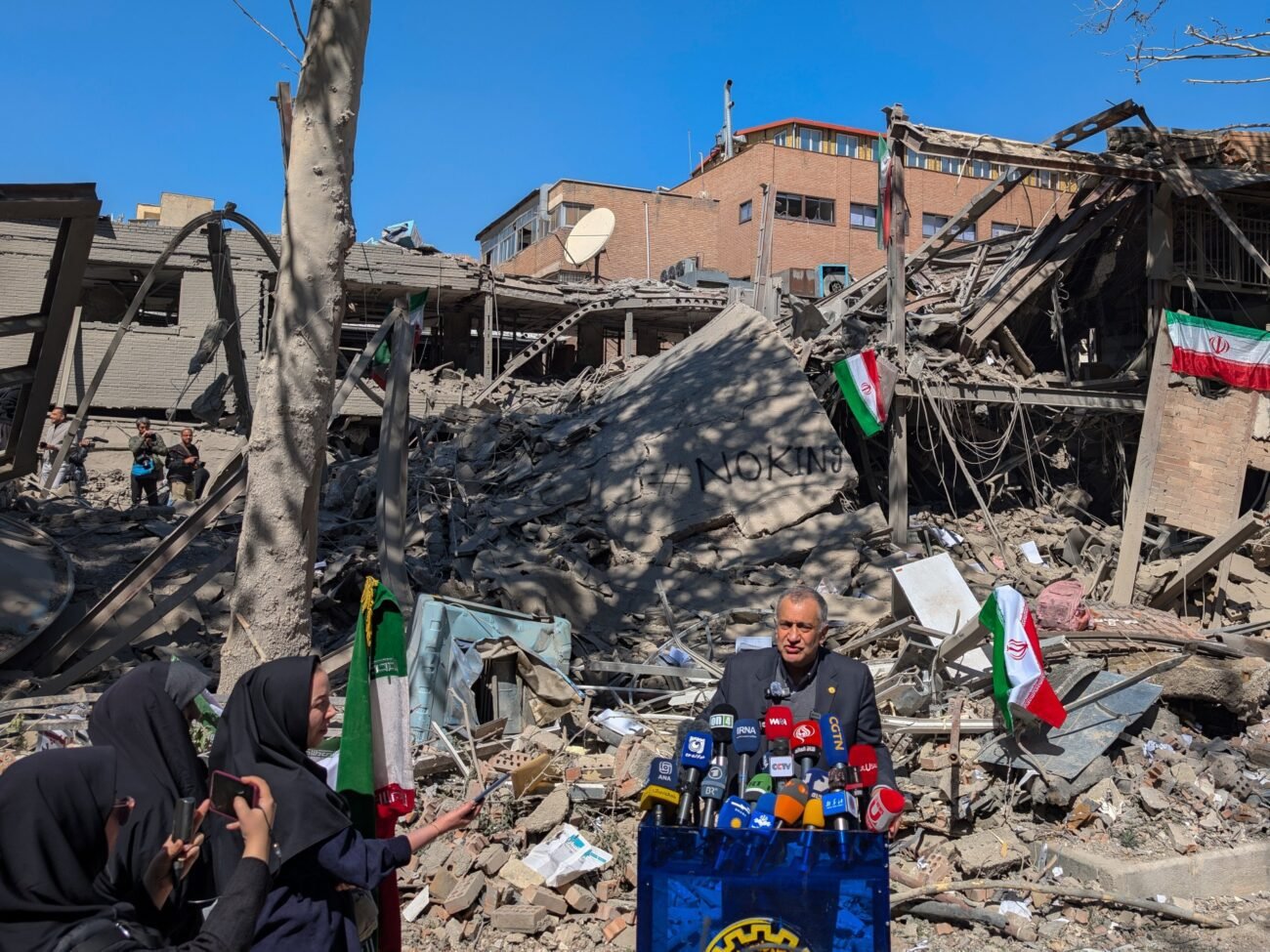
Tehran, Iran – The head of Iran’s top science and engineering university believes that the United States and Israel are targeting symbols of Iran’s progress as a nation, and not merely hitting the governing establishment.
The Sharif University of Technology in Tehran was bombed on Monday, destroying and damaging multiple buildings, including what was described by the authorities as an artificial intelligence centre housing critical databases. The university’s website and other online services went dark.
Recommended Stories
list of 3 itemsend of list
“We believe the reason the enemy targeted these buildings and destroyed the entire infrastructure is that it did not want us to achieve AI technology,” university President Masoud Tajrishi said, adding that the higher education facility had been working on training AI models in Persian for two years and provided services to hundreds of companies.
“The enemy does not want us to succeed or have development and progress, but all our universities are united now by these attacks,” he said at the site of the bombing on Tuesday. Minutes later, another attack targeted the capital, with low-flying cruise missiles visible over downtown Tehran and air defence guns activated.
Tajrishi also said that no country had been prepared to provide Iran with the knowledge and know-how to work on AI technology due to US sanctions and competitive advantages, so all of the research was done domestically.
The US and Israel have not provided an official reason for targeting Iran’s main higher education hubs or cultural heritage sites, which are considered civilian infrastructure. No casualties were reported inside Sharif since all school and university classes are being taken online, but more than 2,000 people have been killed during the war.
The strike on the top university, which was founded six decades ago, came after a string of similar air raids targeting research centres inside other prominent facilities, including the century-old Pasteur Institute, a photonics lab at Shahid Beheshti University and a satellite development lab at the Science and Technology University.
More than 30 universities have been affected by US and Israeli attacks since the start of the war on February 28, Iran’s minister of science, research and technology, Hossein Simaei Saraf, told Al Jazeera last week.
The attacks prompted the Islamic Revolutionary Guard Corps (IRGC) to declare US and Israeli-affiliated universities “legitimate targets”.
Mohammad Hossein Omid, president of Tehran University, wrote a letter on behalf of 15 top university heads last week, urging the IRGC to refrain from attacking other universities in order to show that Tehran is committed to safeguarding higher education facilities anywhere as “human and global heritage” entities.
However, he has since shifted his position and demanded retaliatory attacks in kind after a huge backlash from local hardline media.
The US and Israel have continued to attack across Iran, targeting the country’s infrastructure, hours ahead of US President Donald Trump’s deadline for Iran to capitulate to his demands. The Israeli military has already on Tuesday hit Iran’s railway network, but Trump has threatened to bomb critical civilian infrastructure, such as the country’s main power plants and bridges, which would constitute a violation of international law.
Trump said “a whole civilisation will die tonight” in Iran, with the comment coming days after the country’s steel factories and petrochemical manufacturers were extensively targeted in another move that will affect all of Iran’s population of more than 90 million. He boasted that it would take 20 years for Iran to rebuild if Washington were to withdraw today, but it could take 100 years to rebuild if the war continues.

Hitting Iran or the Islamic Republic?
Inside the Sharif University on Tuesday, a mathematics professor held an online class inside the remains of a bombed building as a show of defiance and continuity.
Placards placed nearby by the authorities read, “Trump’s help has arrived.”
This was in reference to repeated claims by the US president and Israeli Prime Minister Benjamin Netanyahu that they wish to “help” the Iranian people overthrow the Islamic Republic, which came to power after a 1979 revolution but has faced nationwide protests in recent years.
But the increasing systematic targeting of civilian infrastructure has caused deep concerns among many Iranians, especially since the country was already dealing with a host of issues before the war, including economic woes and an energy crisis.
“It was a strange feeling waking up in the morning and seeing your university attacked, not to mention the terror of feeling you might not have electricity to check anything tomorrow,” said a Shahid Beheshti student, who asked to remain anonymous.
“If you can justify attacks on power plants, steel, petrochemicals, bridges, universities and science institutes, you can justify anything,” he told Al Jazeera.
The civilian infrastructure attacks have also prompted local media to lash out against foreign-based Iranians, some of whom have supported US and Israeli attacks in the hope that they would lead to the toppling of the governing establishment of military, political, and theocratic leaders.
The Fars news agency, affiliated with the IRGC, claimed on Tuesday that the attack on Sharif University could not have been possible without “betrayal” from dissidents abroad. It accused Ali Sharifi Zarchi, a top former professor-turned-dissident at Sharif, of leaking the coordinates of the bombed centre, without providing evidence.
Sharifi Zarchi pointed out in a tweet in response that the centre was marked on Google Maps, and said that while he unequivocally condemns the targeting of universities and other civilian sites, “the aim of any attacks should be the overthrow of the Islamic Republic regime, which has held the Iranian people hostage through repression, mass killings, and internet shutdowns.”
The professor circulated a letter published in a number of nongovernment student groups on Tuesday, which also condemned the US and Israeli attacks but said that the establishment was responsible for pursuing policies that put it on a collision course with the two countries and their allies.
“Our people want to work, to study, to breathe, to have access to the internet, and to build their own future,” the students wrote. “Minds that leave do not return. A girl who is detained no longer studies. A child whose school is bombed does not grow up. The cost of these losses will be paid by all of our futures – including those who benefit from this divide today.”
